
In This Article
Here’s a scene every massage therapist eventually lives through: it’s 9 p.m., you just booked a mobile client for tomorrow morning, and you’re staring at your equipment closet wondering if you made the right call three years ago. Stationary vs portable massage table isn’t just a shopping question — it’s a business decision disguised as a furniture purchase, and it quietly shapes your schedule, your back, and your bottom line for years afterward.
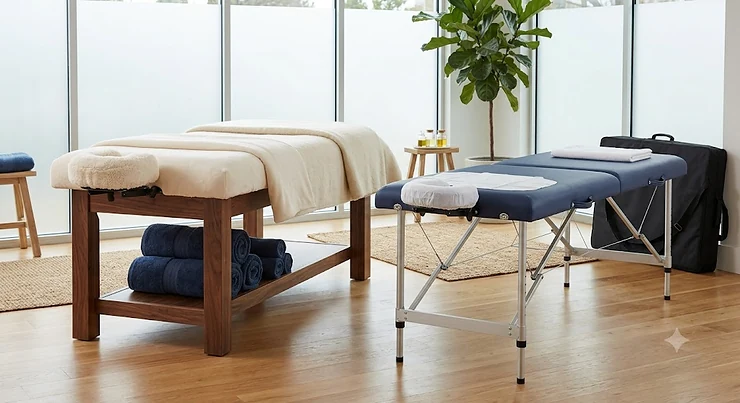
This guide exists because most comparisons online just recite specs. We’re doing something different: real products, real price ranges, and honest commentary on why a given table earns its price tag (or doesn’t). Whether you’re a solo practitioner building a home studio, a mobile therapist chasing corporate wellness contracts, or a spa owner outfitting three treatment rooms, the stationary vs portable massage table debate comes down to a handful of concrete tradeoffs — weight, stability, storage, and how often your table actually needs to move.
We researched seven real, currently available tables spanning budget to premium, across both categories, and we’ll walk through specs, aggregated review sentiment, and genuine buying advice for each. According to the Wikipedia entry on massage tables, tables have long been built as either stationary or portable depending on intended use — a distinction that’s only gotten more nuanced as manufacturing has improved. Let’s dig into what actually separates a fixed table from a folding one, and which side of that line you belong on.
Quick Comparison Table: Stationary vs Portable Massage Table at a Glance
| Table | Type | Price Range | Weight | Best For |
|---|---|---|---|---|
| Master Massage Del Ray Pro | Portable | Around $270-$350 | 34 lbs | Budget-conscious mobile therapists |
| EarthLite Harmony DX | Portable | $400s-$500s range | ~32 lbs | Everyday mobile practice |
| Stronglite Premier | Portable | $600-$750 range | ~38 lbs | Deep tissue and sports massage on the go |
| Saloniture Professional Stationary | Stationary | Under $400 | ~90 lbs | Home studios needing storage |
| EarthLite Sedona Flat Top | Stationary | $1,199-$1,249 | ~110 lbs | Single-location spa rooms |
| Master Massage Laguna | Stationary | Around $1,349 | ~120 lbs | Growing solo or small-studio practice |
| EarthLite Ellora Vista Electric Lift | Stationary | $2,749-$3,449 | ~200+ lbs | High-volume spas and clinical settings |
Notice the pattern: portable tables cluster in the low-to-mid hundreds because you’re paying mostly for engineering (fold mechanisms, cable systems, lightweight woods), while stationary tables scale in price based on how much of the height adjustment is automated. A manual stationary frame like the Master Massage Laguna costs about what a nice portable table costs, but an electric-lift table like the EarthLite Ellora Vista costs more because a motor and actuator system replace your knees and back. If you’re mostly deciding based on price alone, that difference is really a proxy for how much physical strain you’re willing to absorb every single session.
📋 Ready to compare your options side by side? Bookmark this table before you keep reading — you’ll want to reference it.
Top 7 Stationary and Portable Massage Tables: Expert Analysis
1. Master Massage Del Ray Pro — best entry point for new mobile therapists
The Master Massage Del Ray Pro is the table most new mobile therapists buy first, and there’s a straightforward reason for that: it’s genuinely cheap without being flimsy. At 30 inches wide, 84 inches long, and adjustable from 24 to 34 inches tall, it fits a wide range of client body types and therapist heights. The frame uses 1,500-pound-rated aircraft-grade steel support cables paired with European beech wood legs, giving it a 750-pound working capacity — plenty for virtually any client, and reassuring given how thin the price tag is. The 3-inch multi-layer small-cell foam cushioning is denser than what you’d expect at this price, which matters more than people realize; thin foam telegraphs the table frame to the client’s hips and shoulders within twenty minutes.
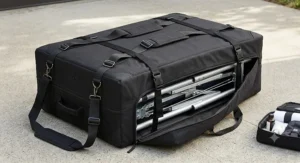
Based on the spec comparison against other budget portables, this table’s main selling point isn’t luxury — it’s that at only 34 pounds, it’s one of the lighter full-size tables you can buy without stepping down to a “lite” frame that sacrifices stability. Reviewers consistently report satisfaction with the cushioning-to-price ratio, though a recurring theme in aggregated feedback is that the included carrying case is serviceable rather than durable over years of daily transport. For a therapist doing a handful of house calls per week, that’s a fair trade. For someone hauling a table five days a week for years, it’s worth budgeting for a case upgrade down the line.
Pros:
- ✅ Genuinely lightweight at 34 lbs for a full-size table
- ✅ 750 lb working capacity exceeds most budget competitors
- ✅ Dense 3-inch cushioning holds up better than the price suggests
Cons:
- ❌ Included carrying case wears faster than the table itself
- ❌ Fewer color and upholstery options than pricier Master Massage lines
At around $270 to $350 depending on the retailer and current promotions, the Master Massage Del Ray Pro delivers strong value for anyone testing whether mobile massage work suits their business model before investing further.
2. EarthLite Harmony DX — most trusted all-around portable table
If the Del Ray Pro is where new therapists start, the EarthLite Harmony DX is often where they land once they know exactly what they want. EarthLite has built its reputation over decades on consistent manufacturing quality, and the Harmony DX reflects that: a 30-inch by 73-inch surface, a matching face cradle, and a proper carrying case that’s built to survive actual daily use rather than occasional trips. What most buyers overlook about this model is that the extra weight over ultra-budget competitors — roughly 32 pounds — buys you a noticeably more rigid frame under load, which you feel the moment a client shifts their weight during deep tissue work.
The company backs its portable tables with a lifetime warranty on the frame for the original purchaser, according to EarthLite’s own product documentation, plus a multi-year warranty on foam and upholstery — a level of manufacturer confidence that budget brands rarely match. Aggregated customer sentiment across retail platforms consistently flags this table as a “grows with you” purchase: therapists who start here rarely feel the need to upgrade unless their practice shifts toward heavier modalities like Thai massage or sports massage, where the added stability of a premium frame becomes worth the extra cost.
Pros:
- ✅ Manufacturer-backed lifetime frame warranty
- ✅ Noticeably more rigid under deep pressure than budget alternatives
- ✅ Carrying case durable enough for daily professional transport
Cons:
- ❌ Costs roughly 40-60% more than entry-level portables
- ❌ Still requires manual folding setup, unlike stationary electric tables
Expect to pay in the $400s to low $500s range for a complete Harmony DX package, which is a fair middle price for a table built to last a full career rather than a few years.
3. Stronglite Premier — best for deep tissue and vigorous modalities on the go
Manufactured under EarthLite’s Stronglite line, the Stronglite Premier exists for one specific problem: portable tables that flex or creak under aggressive pressure. Its Power Lock Support System is engineered specifically to eliminate that flex, and the reinforced center beam tabletop lets a therapist lean into deep tissue, Thai massage, sports work, or Rolfing without the table telegraphing every movement back to the client. The espresso-finished frame also reads as spa-quality the moment you set it up in a client’s living room, which matters more for perceived professionalism than most therapists give it credit for.
Here’s what the spec sheet won’t tell you, but reviewers note repeatedly: the extra rigidity comes with a small tradeoff in setup speed, since the reinforced locking mechanisms take a beat longer to engage than simpler folding designs. For therapists doing five or six mobile appointments a day, that adds up to a few extra minutes of total setup time — a reasonable cost given the 800-pound working weight capacity and the confidence it provides during vigorous techniques. This is the table serious mobile bodyworkers graduate to once their client base skews toward athletes or chronic pain clients who need real pressure.
Pros:
- ✅ Power Lock system virtually eliminates flex under deep pressure
- ✅ 800 lb working weight capacity, among the highest in portables
- ✅ Espresso finish reads as premium in client homes
Cons:
- ❌ Slightly slower setup than simpler folding-leg competitors
- ❌ Premium price puts it out of reach for brand-new practitioners
Priced in the $600 to $750 range as a complete package, the Stronglite Premier is best understood as a specialization purchase rather than a general starter table.
4. Saloniture Professional Stationary Table — budget stationary with built-in storage
Not every home studio needs to move its table, and the Saloniture Professional Stationary Table is built for exactly that reality. It ships with a shelf base, headrest, face cradle, bolster, and arm sling included, which meaningfully undercuts the total cost of buying those accessories separately — a detail easy to miss when comparing sticker prices across brands. The PU synthetic leather upholstery is oil- and water-resistant, a practical feature for anyone using massage oils daily who’s tired of stain anxiety.
On paper, this means Saloniture is competing less on materials-grade luxury and more on functional value: a stationary base at a genuinely low price point, aimed at home-based therapists or estheticians who need one dedicated treatment station and don’t want the complexity of a folding frame. Based on the spec comparison, the open shelf underneath doubles as accessible storage for linens and lotions, effectively replacing a side cart. The honest tradeoff is foam density and frame gauge that don’t match what you’d get from an EarthLite or Oakworks stationary table — acceptable for lighter modalities, less ideal if your practice leans heavily into forceful deep tissue work daily.
Pros:
- ✅ Includes headrest, bolster, and arm sling in one package price
- ✅ Built-in shelf replaces a separate storage cart
- ✅ Oil- and water-resistant upholstery simplifies cleanup
Cons:
- ❌ Foam and frame gauge trail premium stationary brands
- ❌ Not rated for the heaviest deep-tissue or clinical use
Typically priced under $400, the Saloniture Professional Stationary Table is a smart first stationary purchase for a home studio on a tight budget.
5. EarthLite Sedona Flat Top — best mid-range stationary table for a dedicated room
Once a practice outgrows a budget stationary setup, the EarthLite Sedona Flat Top is a natural next step. It’s built with a solid shelf base rather than an open one, giving the room a cleaner, more finished look that clients notice the moment they walk in — a small detail that quietly signals professionalism. The flat-top design keeps the surface fully level rather than contoured, which some modalities (like certain esthetic and bodywork combinations) specifically require.
What most buyers overlook about a table like this is that “stationary” doesn’t mean “basic.” Reviewers consistently describe the Sedona’s cushioning and frame stability as noticeably closer to premium spa-tier tables than its price would suggest, largely because EarthLite applies the same foam and upholstery systems across much of its stationary line regardless of tier. The honest tradeoff here is the same one that applies to every fixed table: you’re committing to a single room. If your lease situation or business model might change in the next couple of years, that’s worth weighing before this purchase.
Pros:
- ✅ Solid shelf base gives treatment rooms a finished, professional look
- ✅ Flat-top surface suits a wider range of modalities than contoured tops
- ✅ Cushioning quality punches above its price tier
Cons:
- ❌ Zero portability if your location or room changes
- ❌ Manual height adjustment only, no motorized lift
Priced between $1,199 and $1,249, the EarthLite Sedona Flat Top sits at the sweet spot for a therapist ready to commit to one dedicated space.
6. Master Massage Laguna — best stationary upgrade for a growing solo practice
The Master Massage Laguna occupies an interesting spot in the lineup: priced above the Sedona but still firmly in “manual, not electric” territory, it’s aimed at therapists who’ve outgrown budget stationary tables but aren’t ready for the cost of a motorized lift system. Based on the spec comparison, Master Massage typically builds its stationary line with the same attention to cushioning depth and upholstery quality found in its higher-end portable tables, just scaled onto a permanent frame.
Here’s what matters in practice: a stationary frame at this price point usually signals a therapist who’s committed to a specific room but still values manual control over height, which some practitioners genuinely prefer over motorized options because it removes one more mechanical thing that can eventually need servicing. Aggregated review themes for Master Massage’s stationary offerings tend to emphasize solid build quality and generous accessory bundling, echoing the brand’s reputation built primarily through its portable line. The honest caveat: because Master Massage is better known for portables, its stationary lineup has a smaller body of long-term user feedback to draw from compared to legacy stationary specialists like EarthLite or Oakworks.
Pros:
- ✅ Strong cushioning and upholstery carried over from Master Massage’s portable expertise
- ✅ No motor to maintain or eventually repair
- ✅ Generous accessory bundling versus comparable stationary competitors
Cons:
- ❌ Smaller long-term review base than legacy stationary brands
- ❌ Manual height adjustment requires more physical effort than electric alternatives
At around $1,349, the Master Massage Laguna works well for a solo practitioner ready to plant roots in a permanent treatment space without jumping straight to electric-lift pricing.
7. EarthLite Ellora Vista Electric Lift — premium pick for high-volume clinical and spa use
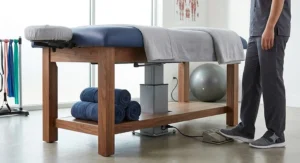
At the top of this lineup sits the EarthLite Ellora Vista Electric Lift, a table built for the reality of a busy spa or clinical practice: multiple clients a day, multiple therapists of different heights sharing one room, and zero tolerance for manual crank adjustments eating into appointment time. The electric lift mechanism adjusts height at the push of a foot pedal or button, which sounds like a luxury until you’ve spent a decade manually adjusting a table between every single client and felt what that repetitive strain does to your shoulders and lower back over the reduction in musculoskeletal strain that ergonomic equipment changes can provide, a documented concern for hands-on healthcare workers.
On paper, the price difference between this and a manual stationary table is entirely about the motor, the actuator, and the reinforced frame needed to support smooth, quiet height transitions under a client’s full body weight. Reviewers and industry buyers consistently describe electric-lift EarthLite tables as the standard against which competing spa tables get measured, particularly for shared treatment rooms where several practitioners of different heights use the same table throughout the day. The tradeoff is obvious and significant: this is a serious financial commitment, and the electric components mean there’s more that could eventually need professional service compared to a purely mechanical frame.
Pros:
- ✅ Motorized height adjustment eliminates manual cranking between clients
- ✅ Ideal for shared rooms with therapists of varying heights
- ✅ Widely regarded as an industry benchmark for electric stationary tables
Cons:
- ❌ Highest price point in this lineup by a significant margin
- ❌ Electric components add long-term maintenance considerations
Priced between $2,749 and $3,449 depending on configuration, the EarthLite Ellora Vista Electric Lift earns its price for high-volume settings where minutes saved per client adjustment compound into real revenue over a year.
✨ Don’t Miss These Exclusive Deals!
🔍 Whichever category fits your practice, click through on any highlighted table above to check current pricing and availability. Prices shift often, so it’s worth comparing current listings before you commit.
Practical Usage Guide: Setting Up and Maintaining Your Table
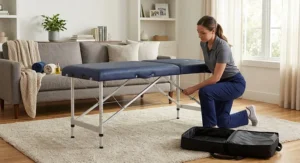
Buying the right table is half the equation — using and maintaining it properly is what makes it last. For portable tables, the single most common first-30-days mistake is skipping the leg-lock check before every session; a leg that isn’t fully engaged is the leading cause of the “table gave way” horror stories therapists swap at conferences. Get in the habit of pressing down firmly on each corner before a client lies down, every single time, no exceptions.
Cushioning maintenance matters more than people expect. Wipe down PU or vinyl upholstery with a mild, non-alcohol-based cleaner after every client — alcohol wipes dry out synthetic leather faster than most therapists realize, leading to premature cracking within a year or two. For stationary tables, especially electric-lift models, schedule a quarterly check of the actuator and foot pedal connections; dust and lotion residue accumulate in the mechanism over time and can eventually cause sticking or uneven lift.
A commonly overlooked optimization: rotate your face cradle padding and bolster covers into a wash rotation rather than waiting until they visibly need it, since bacterial buildup happens well before staining becomes visible. And if you’re using a portable table for mobile work, invest in a second carrying case liner within the first year regardless of brand — the included cases are rarely built for years of daily loading and unloading, and a liner extends the life of the case itself significantly.
Real-World Scenarios: Matching Therapists to the Right Table
Picture three different practitioners, because the “right” table genuinely depends on who’s asking. Consider a massage therapy student doing in-home visits three times a week around a full class schedule, working with a tight budget and a compact car — this is exactly the situation where a table like the Master Massage Del Ray Pro earns its keep, since low weight and low cost matter more than luxury cushioning at this stage of a career.
Now picture a full-time mobile sports massage therapist working with college athletes five days a week, needing a table that survives aggressive Active Release and deep tissue techniques without flexing. That’s the profile the Stronglite Premier was built for — its reinforced frame directly answers the durability concern that matters most in that specific use case.
Finally, picture a spa owner running three treatment rooms with rotating staff of different heights, seeing eight to ten clients per room daily. Manual height adjustment between every client would bleed real minutes off the schedule and real strain onto every therapist’s body. That’s precisely the case for an electric-lift stationary table like the EarthLite Ellora Vista Electric Lift, where the higher upfront cost pays for itself in saved time and reduced injury risk across a staff of multiple practitioners.
Your Treatment Table Decision Framework
Cut through the noise with a simple framework: if you work in more than one location per week, you need portable — full stop, no stationary table solves that problem. If you work from one dedicated room and never plan to move it, stationary wins on comfort, durability, and professional appearance every time. If your budget is under $500, your realistic options are budget-to-mid portables or entry stationary tables like the Saloniture; anything electric is out of reach until your revenue catches up.
If pressure and modality intensity are the priority — deep tissue, sports massage, Thai massage — prioritize frame rigidity over price within whichever category (portable or stationary) fits your mobility needs. And if you’re sharing a treatment room with other practitioners of different heights, an electric-lift stationary table stops being a luxury and starts being a genuine time-and-injury-prevention tool. This treatment table decision ultimately isn’t about which table is “better” in the abstract — it’s about which one matches how and where you actually work.
What Is a Stationary vs Portable Massage Table?
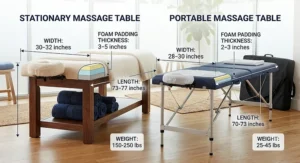
A stationary massage table is a fixed-frame table designed to remain in one location permanently, typically offering greater stability, thicker cushioning, and sometimes motorized height adjustment. A portable massage table folds for transport, trading some stability and cushioning depth for the ability to travel between client locations.
That’s the textbook definition, but the practical distinction runs deeper. A stationary table’s frame doesn’t need to compromise for foldability, so manufacturers can build in reinforced center supports, wider bases, and heavier-gauge cushioning without worrying about how it packs into a carrying case. Portable tables, by contrast, are engineering exercises in tradeoffs: every pound saved for easier carrying is a pound not available for extra stability or padding. Neither approach is objectively superior — they’re optimized for entirely different working conditions, and the right answer depends entirely on whether your table needs to leave the building.
Should I Buy Stationary or Portable Massage Table? How to Choose
Answering “should I buy stationary or portable massage table” comes down to seven practical criteria, each worth weighing honestly against your actual business model rather than an idealized one:
- Location count. If you work in more than one place weekly, portability isn’t optional — it’s a requirement, regardless of how appealing a stationary table’s comfort looks on paper.
- Vehicle and physical capacity. Even the lightest portable table still needs to be lifted and carried; be honest about what you can manage daily without injury.
- Client volume per day. High daily client counts favor stationary tables, especially electric-lift models, because repeated manual adjustments add up to real physical strain over a full shift.
- Modality intensity. Deep tissue, sports massage, and similarly forceful techniques favor whichever option — portable or stationary — has the more reinforced frame in your price range.
- Room permanence. A month-to-month lease or a home studio that might relocate argues against a fixed table you can’t easily bring with you.
- Budget ceiling. Portable tables generally offer more capability per dollar at the low end; stationary tables offer more comfort and durability per dollar once you’re spending over $1,000.
- Growth trajectory. If you expect to add staff or shared rooms within a couple of years, a stationary electric-lift table often pays for itself faster than expected.
Working through these seven factors honestly will point you toward an answer faster than reading spec sheets ever will.
Fixed vs Folding Massage Table: Common Mistakes When Buying
The most common mistake in the fixed vs folding massage table decision is buying based on price alone without accounting for total cost of ownership. A $270 portable table that needs a case replacement in year two and a foam replacement in year four isn’t actually cheaper than a $500 table built to last a decade — it just spreads the cost differently.
A second frequent error: underestimating weight tolerance in daily use. Therapists routinely buy the lightest portable table available, then discover within a few months that the reduced frame gauge that made it light also makes it flex uncomfortably during firmer pressure work. Reviewers across multiple budget portable brands consistently flag this exact tradeoff. A third mistake is buying a stationary table before confirming a location is actually permanent — plenty of therapists have bought a beautiful fixed table only to relocate within a year and face the logistics of moving something never designed to be disassembled easily. Finally, buyers frequently skip verifying working weight capacity against their actual client base, which matters both for safety and for long-term frame integrity regardless of which category you choose.
Permanent vs Travel Massage Table: A Detailed Comparison
The permanent vs travel massage table debate really comes down to a single question dressed up in different clothes: does your table need to disappear at the end of the day, or does it get to stay exactly where it is? A permanent table can dedicate its entire structural budget to comfort and stability since it never needs a folding hinge, a locking leg mechanism, or a lightweight frame material. A travel table, meanwhile, is defined by compromise — every folding joint is a potential weak point that engineers have to reinforce, and every ounce of weight saved for carrying comes from somewhere in the padding or frame gauge.
In practice, this plays out clearly across the products covered above. The EarthLite Ellora Vista Electric Lift, freed from any need to fold, can house a full motor and actuator system inside a reinforced frame. The Stronglite Premier, needing to remain foldable, instead solves the stability problem through a clever locking mechanism rather than sheer mass. Neither solution is inferior — they’re just answering different engineering questions. If you genuinely need both — say, a home studio table plus an occasional travel table for special events — many therapists eventually own one of each rather than trying to force a single table to do both jobs well.
Pros and Cons of Stationary Massage Table Ownership
Beyond the individual products above, it’s worth stepping back and weighing the pros and cons of stationary massage table ownership as a category decision, separate from any specific model. On the plus side: stationary tables typically offer superior cushioning depth, since they’re not weight-constrained; they project more professionalism to walk-in clients, particularly in a spa or clinic setting; and higher-end electric models dramatically reduce physical strain on the therapist across a demanding daily client load.
The downsides are equally real. A stationary table locks you into a single location, which limits business flexibility if you ever want to add mobile services or relocate your practice. Stationary tables also represent a larger upfront investment, particularly once you move into electric-lift territory, and that capital could otherwise go toward marketing, continuing education, or other business needs early in a career. For many therapists, the right call ends up being a stationary table for a primary location paired with a portable table reserved for occasional off-site work — getting the comfort benefits where you spend most of your time without losing all flexibility.
Long-Term Cost & Maintenance: Total Cost of Ownership
Sticker price tells an incomplete story. A budget portable table around $270 might need a new carrying case (roughly $60-$80) within two years and replacement foam or upholstery (another $100-$150) within four to five years of regular mobile use — pushing effective five-year cost closer to $450-$500. A mid-range portable like the EarthLite Harmony DX, backed by a lifetime frame warranty, often avoids that replacement cycle almost entirely, meaning its higher upfront price can actually work out cheaper over a five-year window.
Stationary tables follow a similar logic but at a different scale. A manual stationary table like the Master Massage Laguna has essentially no moving parts to maintain beyond occasional upholstery care, keeping long-term costs predictable. An electric-lift table like the EarthLite Ellora Vista Electric Lift carries a real, if infrequent, cost of eventual actuator or motor servicing — but for a spa running multiple clients daily, the time saved on manual adjustments (multiplied across every therapist, every day, for years) often dwarfs that occasional service expense. According to BLS data on the massage therapy profession, demand for massage therapists continues to grow well above the average across all occupations, which means equipment durability increasingly functions as a direct input into how many years of full earning capacity your body can sustain.
Features That Actually Matter (And Those That Don’t)
Cutting through marketing language: working weight capacity actually matters, but only up to a point — anything above 600 pounds is functionally overkill for the vast majority of client bodies, so don’t pay a premium chasing an 1,100-pound rating you’ll never approach. Cushioning density matters enormously and is worth prioritizing over cosmetic details like frame color or stitching pattern, since it directly affects client comfort session after session.
Carrying case quality matters far more than most first-time buyers assume, particularly for anyone doing regular mobile work — a flimsy case leads to real frustration within months. On the “doesn’t matter as much as advertised” side: built-in lighting features, decorative wood grain finishes, and oversized accessory pocket counts are pleasant but rarely decisive factors in whether a table serves your practice well. Focus your comparison energy on frame rigidity, cushioning depth, warranty terms, and working weight capacity — those four factors predict satisfaction far better than anything else on a spec sheet.
Safety, Regulations & Compliance Guide
Table safety isn’t just about weight capacity, though that’s the most visible factor. Regularly inspect folding leg locks, cable tension on portable frames, and actuator function on electric tables — a failure in any of these during a session is a genuine liability risk, not just an inconvenience. Keep manufacturer documentation on hand, since some liability insurance policies for massage therapists request proof of equipment maintenance in the event of a claim.
Ergonomic safety for the therapist deserves equal attention. Prolonged awkward posture and repetitive height adjustment are recognized contributors to musculoskeletal strain in bodywork professions, and the National Center for Complementary and Integrative Health’s overview of massage therapy notes that massage therapy, while generally low-risk for clients when performed by trained practitioners, still requires attention to technique and physical conditions on the practitioner’s side of the table. Choosing table height-adjustment features that reduce repetitive strain isn’t a luxury consideration — over a multi-decade career, it’s one of the more consequential decisions a therapist makes for their own longevity in the profession.
Frequently Asked Questions
❓ Is a stationary or portable massage table better for a home-based practice?
❓ How much does a good portable massage table weigh?
❓ Do electric lift massage tables need much maintenance?
❓ Can a stationary massage table be moved at all?
❓ What's the biggest mistake people make when choosing between stationary and portable tables?
Conclusion
The stationary vs portable massage table decision isn’t really about which category is objectively better — it’s about matching equipment to how your practice actually operates. A mobile therapist forcing themselves into a stationary table setup will constantly fight their own equipment; a spa forcing a portable table into daily high-volume use will burn through it faster than expected. The seven tables covered here span the realistic range most therapists will consider, from the budget-friendly Master Massage Del Ray Pro to the premium EarthLite Ellora Vista Electric Lift, and each earns its place for a specific kind of practice rather than being universally “best.”
If there’s one takeaway to carry forward, it’s this: buy for the business you actually run today, not the one you imagine running someday. You can always upgrade as client volume, modality mix, or location needs change — and plenty of thriving practices end up owning both a stationary and a portable table once their business matures enough to need both.
Recommended for You
- Massage Table for Esthetician: 7 Best Picks in 2026
- Massage Table for Spa: 7 Picks Spas Trust in 2026
- Stationary Massage Table Guide: 7 Best Picks for 2026 Pros
Disclaimer: This article contains affiliate links. As an Amazon Associate, I earn from qualifying purchases. If you purchase products through these links, we may earn a small commission at no additional cost to you.
✨ Found this helpful? Share it with your friends! 💬🤗
