In This Article
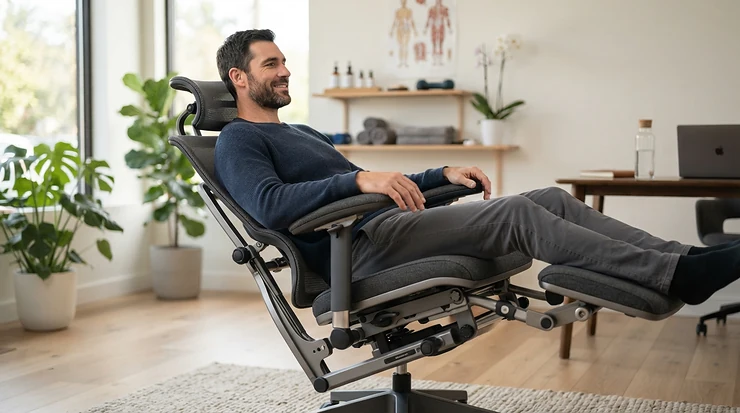
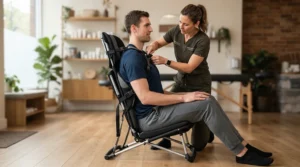
An adjustable massage chair for tall clients is a seated-massage chair whose seat, chest pad, armrest, and face cradle can be raised, angled, and extended far enough to keep a taller body neutrally aligned. The neck stays relaxed, the shoulders supported, and the knees uncramped, instead of the client being folded into a chair built for the “average” body.
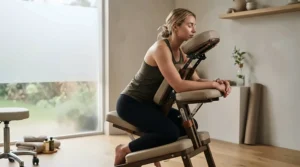
Picture a 6’5″ client lowering himself onto a standard portable chair. His knees are pinned against the pads and his neck is craned. His hands hunt for an armrest that ends somewhere around his elbows. He’ll say it’s fine. It isn’t.
For a therapist, that mismatch is a business problem, not just a comfort problem. Clients who feel cramped don’t rebook, and a chair that can’t fit your tallest regular quietly caps your calendar. Chair massage is a young craft. Massage Magazine’s history of the massage chair dates the first purpose-built chair to 1986. Manufacturers have spent decades improving adjustability since, yet product pages still shout “fully adjustable” and bury the actual numbers.
This guide digs those numbers out. You’ll get seven real chairs, honest analysis of what their specs mean for long torsos and long limbs, and practical fitting routines. I built it from manufacturer specifications, retailer listings, and published ergonomics research, not hands-on testing, so every claim is grounded in something documented. Prices appear as ranges only, so check current price and availability before you buy.
Quick Comparison: Adjustable Massage Chair for Tall Clients at a Glance
| Product | Working Weight | Chair Weight | Price Range | Best For |
|---|---|---|---|---|
| Ergo Pro II | 600 lb | 19-24 lb (listings vary) | $500-$700 range | Tallest and heaviest clients |
| Portal Pro | 350 lb | 19 lb | Mid-$400s to low-$700s | All-round pros who want wheels |
| Avila II | About 350 lb (158 kg) | Not stated | Premium tier | Fast lever adjustments |
| Vortex | 300 lb (136 kg) | About 15 lb (6.8 kg) | Check current price | Travel-heavy therapists |
| Portal Light | 300 lb | 15 lb | Mid-$400s | Lightest QuickLock option |
| Master Massage Professional | Listings vary | 15.2 lb | $350-$400 range | Value with a six-way face cradle |
| Melody | 300 lb | 18 lb | $275-$350 range | Budget buyers |
Looking at the comparison above, Ergo Pro II is the only chair that publishes a client height range, and its 600 lb working weight dwarfs the 300-350 lb ratings on most rivals. Portal Light and Vortex trade capacity for a carry weight near 15 lb. Melody undercuts everyone on price but shares the same 300 lb ceiling.
💬 Just one click — help others make better buying decisions too!😊
Top 7 Adjustable Massage Chairs for Tall Clients: Expert Analysis
A quick note on method. During research I found detailed specs for all seven chairs, but I couldn’t verify a meaningful body of independent customer reviews for any of them. Rather than invent sentiment, each entry says what’s verifiable and points you to current buyer reviews. Availability and pricing also vary between Amazon and specialty massage retailers, so treat every price below as a range.
1. Ergo Pro II — the only chair with a published 6’6″ ceiling
Most brands wave at “fits all sizes.” The Ergo Pro II from Stronglite (sold under the Earthlite umbrella) prints an actual range: clients from 4’6″ to 6’6″. That makes it the easiest chair here to justify as an adjustable massage chair for tall clients.
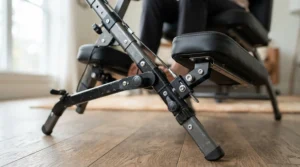
The aluminum frame carries a 600 lb working weight. That headroom matters because taller clients often bring more total mass and leverage to the chair. Telescoping legs let you set the chair to your working height rather than the client’s, which is arguably the most underrated feature for a therapist who would otherwise stoop over a long torso. The seat angle adjusts and can be reversed for leg, foot, or anterior torso work, and the knee rests come off for clients who simply need more legroom.
Based on the spec comparison, this is the chair to shortlist first if your calendar includes clients above 6’2″. The package includes a Deluxe Adjustable Platform with a FacePillow, though the listings don’t state the platform’s vertical travel in inches. Listed chair weight also varies between roughly 19 and 24 lb, so confirm before you plan to carry it up stairs.
On reviews, I couldn’t verify a robust independent sample. Read current buyer feedback and search specifically for mentions of tall clients.
Pros:
- ✅ Published client range up to 6’6″
- ✅ 600 lb working weight for serious headroom
- ✅ Telescoping legs plus removable knee rests
Cons:
- ❌ Platform travel not published in inches
- ❌ Listed chair weight varies by source
Expect roughly a $500-$700 range depending on retailer and package. The value verdict is that it’s the strongest buy when height range is your top priority.
2. Portal Pro — the QuickLock face rest with near-unlimited positioning
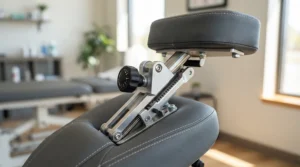
The Oakworks Portal Pro earns its reputation on the face rest. The patented QuickLock design is described as having virtually unlimited positioning, which is exactly what a taller head-to-chest ratio demands.
The chair weighs 19 lb, carries 350 lb, and rolls on built-in wheels, so you can move it without lifting. The seat, face rest, and armrest adjust for height and angle, and the foam is firm in the seat and knee pads but softer in the chest and armrest. That combination keeps a long torso supported without pressure points where the client’s weight concentrates.
The owner’s manual walks through a setup sequence, including a reminder to extend the cable fully before anyone sits down. The chest pad can be swapped for an optional sternum pad, sold separately. My analytical take is that it’s an excellent match if you already work with a mix of body types. The listings I reviewed don’t state a client-height ceiling, so verify fit with your tallest regular before committing.
Verified review data was thin in the sources I checked. Skim current buyer comments for notes on the face rest and seat depth.
Pros:
- ✅ QuickLock face rest offers wide positioning
- ✅ Built-in wheels ease transport
- ✅ Made in the USA with a carry case included
Cons:
- ❌ No published client-height ceiling
- ❌ Sternum pad costs extra
Retail listings run from the mid-$400s to the low-$700s, so shop around. It’s a solid-value pick for working professionals.
3. Avila II — lever-based adjustments for speed between clients
The Earthlite Avila II takes a different engineering route: a patented composite frame instead of tube aluminum. Three quick levers handle the main adjustments, which is a real advantage when you’re fitting a new client between appointments.
The UK retailer listing I found describes accommodation from children up to adults around 158 kg, roughly 350 lb. Soft Support removable pads with Natursoft upholstery cover the comfort side, and the package includes a wheeled carry case, sternum pad, and valuables pouch. Fewer adjustment points means faster fitting, but it may also mean fewer fine-grained options at the extremes. That’s worth testing if you routinely treat clients over 6’4″.
The honest caveat is sourcing. Most of what I found comes from one UK listing that showed the chair as sold out, so confirm current US specifications and availability with a dealer. Independent review data wasn’t verifiable in my research.
Pros:
- ✅ Three quick levers speed up fitting
- ✅ Wheeled case and sternum pad included
- ✅ Composite frame with removable pads
Cons:
- ❌ Client-height range not published
- ❌ Specs sourced mainly from a UK listing
It sits at the premium end of the portable category, so check current price. It’s best for therapists who value fitting speed.
4. Vortex — compact, curvy, and built for the road
The Earthlite Vortex uses oval-tube aluminum for a frame that looks more sculpted than most. The oval profile is meant to add stability without adding weight.
At about 6.8 kg (roughly 15 lb) with a 136 kg (about 300 lb) working weight, it’s a light chair with a fair capacity. Multiple face, arm, and seat adjustments and two-layer Pro-Lite cushioning round out the comfort side. The package adds a carry case, sternum pad, and strap. A light frame is a joy to carry, but lighter chairs generally have less mass to resist the leverage of a taller client leaning forward. The 300 lb rating is fine for most, and heavier or very tall clients may be better served by Ergo Pro II.
I couldn’t verify a US price during research, so check current price with a dealer. Review data was also not verifiable in what I retrieved.
Pros:
- ✅ Roughly 15 lb for easy carrying
- ✅ Sternum pad, strap, and case included
- ✅ Two-layer Pro-Lite cushioning
Cons:
- ❌ 300 lb working weight limits heavier clients
- ❌ No published client-height ceiling
The value verdict is that it suits travel-heavy therapists whose tall clients aren’t also very heavy.
5. Portal Light — the lightest way to get a QuickLock face rest
The Oakworks Portal Light is the stripped-down sibling of the Portal Pro. It’s built from aerospace-grade aluminum and weighs about 15 lb, which makes it easy to carry all day.
It keeps the QuickLock face rest, adds an AeroCel crescent, and offers manual height and angle adjustments for the seat, face rest, and armrest. The capacity is 300 lb. What you give up against the Pro is 50 lb of rating, and the listing I saw doesn’t mention built-in wheels. Its carry strap and case handle transport instead.
My take is that this is the chair for the therapist who carries daily and treats mostly average-to-tall clients rather than the very heaviest. The listings don’t state a height ceiling, so the “any size client” language should be verified against your actual roster.
Independent reviews weren’t verifiable in my sources, so check current buyer feedback on face rest travel.
Pros:
- ✅ Around 15 lb for easy daily carrying
- ✅ QuickLock face rest retained
- ✅ Aerospace-grade aluminum frame
Cons:
- ❌ 300 lb working weight
- ❌ Built-in wheels not mentioned in listing
Expect a price around the mid-$400s. It’s decent value if portability is your priority.
6. Master Massage Professional — a six-way face cradle at a friendly price
The Master Massage Professional puts its adjustability story in the face cradle. The listing describes an innovative six-way adjustable design, which is the feature that matters most for a taller client’s neck alignment.
It weighs 15.2 lb and uses an aircraft aluminum frame, small-cell foam padding, and a cushioned sternum bolster. It comes with a luggage-style wheeled carry case and a session pouch for eyewear and jewelry. That case is a small luxury for anyone who commutes between clients.
Here is where I’d flag a discrepancy. One US retailer lists a 1,000 lb working weight, while a UK retailer lists about 295 kg (roughly 650 lb). Those numbers can’t both be right, so verify the rating with the manufacturer before relying on it for heavy clients. Height range isn’t published either.
I couldn’t verify independent customer reviews, so check current buyer feedback for cradle stability.
Pros:
- ✅ Six-way adjustable face cradle
- ✅ Wheeled carry case included
- ✅ Lifetime limited warranty listed
Cons:
- ❌ Working-weight claims conflict between listings
- ❌ No published client-height ceiling
Retail listings sit in a $350-$400 range. It’s good value for face cradle flexibility.
7. Melody — the budget entry with real adjustability
The Custom Craftworks Melody is the budget pick, but its adjustment list is longer than the price suggests. It offers seat height and angle, an adjustable chest pad, an adjustable headrest, arm height and angle, and a removable sternum pillow.
It weighs about 18 lb and carries 300 lb. The listing gives dimensions of 17.5″W x 50″L x 44.5″H and includes 2-inch fire-retardant foam and a carry case. Since no client-height ceiling is published, I’d treat it as the value pick for taller-but-not-extreme clients. Verify fit with a demo or return policy before buying several.
Review data wasn’t verifiable in my sources. Read current buyer comments before ordering.
Pros:
- ✅ Seat, chest, headrest, and arm adjustments
- ✅ Removable sternum pillow included
- ✅ Lowest price of the seven
Cons:
- ❌ 300 lb working weight
- ❌ No published client-height ceiling
Listings generally fall in a $275-$350 range. The value verdict is strong for new practitioners on a budget.
| Product | Standout Adjustment | Face Support | Best For |
|---|---|---|---|
| Ergo Pro II | Telescoping legs, reversible seat | Deluxe platform with FacePillow | Clients up to 6’6″ |
| Portal Pro | Seat, face, and arm height and angle | QuickLock face rest | All-round professionals |
| Avila II | Three quick levers | Not detailed in listing | Fast fitting |
| Vortex | Multiple face, arm, and seat settings | Adjustable per listing | Travel-heavy work |
| Portal Light | Manual height and angle | QuickLock plus AeroCel crescent | Lightest carry |
| Master Massage Professional | Six-way face cradle | Six-way adjustable cradle | Cradle flexibility on a budget |
| Melody | Seat height and angle | Adjustable headrest | New practitioners |
The table shows that fit flexibility lives in different places on different chairs. Ergo Pro II puts it in the frame and legs, the Oakworks pair in the face rest, and Master Massage Professional in the cradle. Choose based on where your tallest clients are most likely to feel cramped.
Client Comfort Fitting: A 10-Minute Setup Routine for Tall Clients
Client comfort fitting is a sequence, not a guess. Follow the order below and most tall-client complaints disappear before the massage starts.
- Set your own working height first. If your chair has telescoping legs, like the Ergo Pro II, adjust to your body before the client sits. Your posture shouldn’t depend on their height.
- Set the seat. Height and angle should leave the thighs supported without pinning the knees. Reverse or remove the knee rests if legs are long.
- Position the chest pad. The client should lean into it naturally without their shoulders rolling forward.
- Adjust the armrest. Aim for relaxed shoulders and elbows slightly bent.
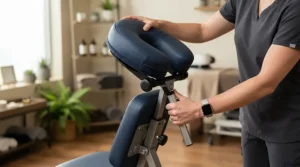
- Set the face cradle last. Height and angle are the final tweak, because the neck is what everything else serves.
- Ask, then recheck after two minutes. People settle into a chair, and fit changes as they relax.
Maintenance matters too. Stronglite’s setup guide tells owners to inspect the chair before every use and warns against loading full body weight onto the knee rests. Common first-30-day mistakes include over-tightening cam locks, skipping the inspection, and forgetting to re-fit clients who return after weeks away. A good client comfort fitting habit takes ten minutes once and saves hours of rebooking friction.
Real-World Scenarios: Matching Tall Clients to the Right Chair
Chairs make more sense when you picture a working week.
Scenario 1: The mobile corporate therapist. She visits offices three days a week, treats a 6’5″ software lead every other Thursday, and carries her chair up stairs. She needs published height range and heavy-duty capacity, so Ergo Pro II is her shortlist leader. The extra weight is a fair trade for the certainty. Budget: $500-$700 range.
Scenario 2: The studio owner with mixed clientele. He works from a fixed location, sees varied body types, and cares about a consistent client experience. Portal Pro fits: wheels handle repositioning, the QuickLock face rest handles cradle changes, and 350 lb covers most of his calendar. Budget: mid-$400s to low-$700s.
Scenario 3: The massage student on a shoestring. She practices on classmates for school events and needs something forgiving. Melody or Master Massage Professional fits her budget, and she can test the adjustments on her tallest classmate before buying. Budget: $275-$400 range.
The pattern is simple. Pick the chair by your tallest realistic client and your carrying reality, not by the average of your calendar.
How to Choose an Adjustable Massage Chair for Tall Clients
To choose an adjustable massage chair for tall clients, prioritize a published client height range, working weight with margin, and adjustment travel in the seat, armrest, and face cradle. Then weigh portability against stability. Here are seven steps, in order.
- Start with your tallest realistic client. The CDC’s measured data put the average U.S. man at about 68.9 inches and the average woman at about 63.5 inches. Tall clients live in the tail of that curve, where “average” adjustments run out.
- Demand a published height range. Of these seven, only Ergo Pro II states one. Ask sellers for numbers on the rest.
- Check working weight with margin. Height and weight often travel together, so favor a rating well above your heaviest expected client.
- Inspect massage chair extended height adjustment. Look at seat height, chest pad travel, and leg adjustment.
- Test adjustable face cradle height and angle. The neck should stay neutral without straining.
- Confirm massage chair armrest adjustment range. Check both height and pad length.
- Weigh portability against stability. A 15 lb chair is lovely to carry, but a 600 lb rating is lovely to trust.
Massage Chair Extended Height Adjustment: What the Numbers Really Mean
Massage chair extended height adjustment is the least standardized number in this category. Brands rarely publish it in inches, and they mean different things by it. Some refer to the telescoping legs that set the chair to the therapist’s working height. Others mean seat height or chest pad travel, which set the client’s posture.
Both matter for tall clients, but for different reasons. Leg height protects you: raise the chair so a longer torso doesn’t drag your shoulders and back into a permanent stoop. Seat and chest pad travel protect them: they keep hips, ribs, and neck in a sensible stack. Ergo Pro II documents telescoping legs explicitly. The Melody lists a 44.5″ height in its dimensions, but the listing doesn’t say whether that’s folded or working height.
The practical move is to ask the seller three questions: what’s the maximum working height, what’s the maximum distance from seat to face cradle, and does the chest pad extend or slide? If they can’t answer, that tells you something about massage chair extended height adjustment on that model.
Face Cradle Sizing for Tall Clients and Adjustable Face Cradle Height
Face cradle sizing for tall clients is about neck posture. If the cradle sits too low relative to a long torso, the client’s neck has to crane downward. If it sits too high, the chin tucks awkwardly. The right adjustable face cradle height leaves the head level with the spine.
Look at how each chair handles this. Master Massage Professional advertises a six-way adjustable cradle, the widest published range of cradle movement here. The Oakworks pair, Portal Pro and Portal Light, rely on the QuickLock face rest, which Oakworks describes as having virtually unlimited positioning. Ergo Pro II ships with a Deluxe Adjustable Platform and a FacePillow with CloudFill cushioning, described in one listing as memory foam that conforms to face shape.
What the spec sheets don’t say is how far the cradle rises above the chest pad. Face cradle sizing for tall clients depends on that travel, so ask for it. Also keep in mind that on Portal Pro the chest pad can be replaced with a sternum pad, which changes chest support and can shift the cradle’s relative position.
Massage Chair Armrest Adjustment Range and Ergonomic Reach Range
Armrests do two jobs. They support the client’s arms, and they set how far you must reach to work the shoulders and neck. Massage chair armrest adjustment range therefore affects both of you.
Earthlite’s spec sheet for Ergo Pro II lists an arm pad of 21.5″ x 7.5″ x 1.5″, a useful data point because pad length matters for long forearms. Most other listings describe height and angle adjustments without numbers. Melody and Portal Light both list arm height and angle changes.
Ergonomic reach range matters because massage is physically demanding. A Massage Therapy Foundation job task analysis found that therapists spend significant treatment time in mild trunk and shoulder flexion, and that these non-neutral postures add up as cumulative stress. A taller seated torso pushes the working surface higher, so your ergonomic reach range shifts. Raising the chair’s working height, where legs allow it, keeps your posture upright.

Adjustable Massage Chair vs Massage Table for Tall Clients
| Option | Tall-Client Fit | Setup Effort | Best For |
|---|---|---|---|
| Portable adjustable chair | Depends on published range | Minutes | Events, offices, short sessions |
| Portable massage table | Length usually generous | Longer | Full-body work |
| Stool with desktop face cradle | Depends on the stool | Quick | Desk-side sessions |
Chairs and tables solve different problems. A table gives a tall client room to lie flat, but it can’t deliver a ten-minute seated session in an office corridor. A chair opens locations a table can’t reach. The Massage Magazine history even mentions the desktop face cradle that lets a client sit on an ordinary stool.
The table analysis is simple. If your work is mostly full sessions in a studio, a table serves tall clients better. If your work is events, corporate wellness, and short seated treatments, a well-fitted adjustable massage chair for tall clients wins on portability and setup time.
Common Mistakes When Buying an Adjustable Massage Chair for Tall Clients
- Trusting “fits all sizes” copy. Without a published range, the phrase means little.
- Ignoring working-weight margin. Height often comes with weight, so buy headroom.
- Adjusting the face cradle first. Set seat, chest, and armrest before the cradle.
- Forgetting your own height. A study of massage practitioners in Taiwan linked inappropriate working-table height with lower-back symptoms. It’s a small, specific sample, but the lesson is easy to apply: your working height deserves as much thought as the client’s fit.
- Skipping pre-session inspection. Loose fasteners and worn parts are the boring path to failure.
Notice that most of these mistakes come from buying by adjectives rather than adjustments.
Features That Actually Matter (And Those That Don’t)
Matters: telescoping legs, a reversible or angle-adjustable seat, removable knee rests, wide face cradle travel, working weight with margin, and replaceable pads.
Doesn’t matter as much: upholstery color choices, marketing terms like “aircraft-grade” on their own, and bonus pouches. They’re pleasant but rarely change fit.
Between the two lists sits an honest gray zone. Wheels are a convenience that becomes essential if you carry daily, and a lifetime frame warranty matters if you buy for a busy practice. Neither will fix a chair that can’t adjust far enough for your tallest client.
✨ Don’t Miss These Exclusive Deals!
🔍 Take your practice to the next level with these carefully selected chairs. Click on any highlighted item to check current pricing and availability. The right adjustable massage chair for tall clients will help you create the comfortable sessions your regulars will rebook.
Price Range and Value Analysis
| Tier | Chairs | Price Range | Value Verdict |
|---|---|---|---|
| Budget | Melody, Master Massage Professional | $275-$400 range | Best entry value |
| Mid-range | Portal Light, Vortex | Mid-$400s and up | Light and portable |
| Premium | Portal Pro, Avila II, Ergo Pro II | $500-$700 range and up | Best for heavy or tall clients |
Total cost of ownership runs beyond the sticker. A chair used daily amortizes quickly, while a chair that can’t fit your tallest client costs you the booking. Spread over a year of weekly sessions, a $150 price difference is small next to a single lost regular. On paper, the premium tier earns its cost when your calendar includes clients at the extremes.
The analysis is straightforward. Budget chairs suit clients within typical adjustment ranges, mid-range chairs suit portability-first workflows, and premium chairs suit fit-first workflows. Always check current price, since retailers vary.
FAQ
❓ How tall of a client fits on a portable massage chair?
❓ How much does an adjustable massage chair for tall clients cost?
❓ What working weight should I look for?
❓ Can I swap the chest pad for a sternum pad?
❓ Do lightweight chairs feel stable with tall clients?
Conclusion
The right adjustable massage chair for tall clients isn’t the one with the loudest “fully adjustable” claim. It’s the one whose numbers match your calendar. If you regularly treat clients near or above 6’5″, Ergo Pro II is the clear starting point because it publishes a height range and a 600 lb working weight. If face rest flexibility matters most, Portal Pro and Master Massage Professional deserve a look, while Portal Light and Vortex suit the therapist who carries daily. Avila II rewards fast fitting, and Melody gets new practitioners started on a small budget.
Whatever you choose, follow the fitting routine: your height first, then seat, chest, armrest, and face cradle last. Ask sellers for massage chair extended height adjustment numbers, face cradle sizing for tall clients, and your ergonomic reach range needs before you buy. Do that, and your tallest clients will stop being the ones who politely endure the chair and start being the ones who rebook.
Recommended for You
- 7 Best Heavy Duty Massage Chairs For High Volume Spas (2026)
- 7 Top Rated Massage Chairs Of 2026: Budget-Friendly Picks
- Portable Massage Chair vs Stationary Salon Chair: 7 Picks For 2026
Disclaimer: This article contains affiliate links. As an Amazon Associate, I earn from qualifying purchases. If you purchase products through these links, we may earn a small commission at no additional cost to you.
✨ Found this helpful? Share it with your friends! 💬🤗
