In This Article
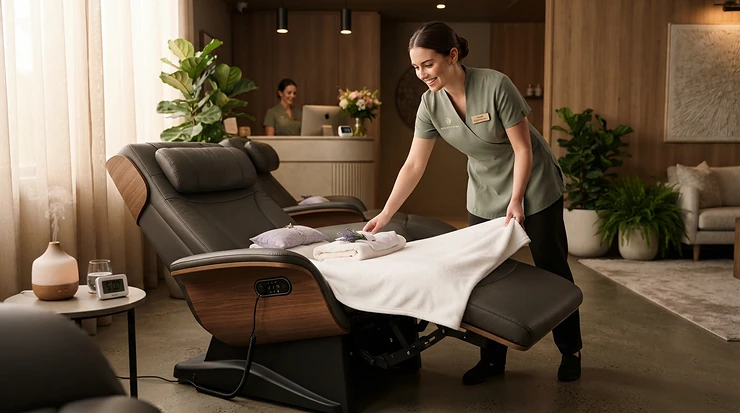
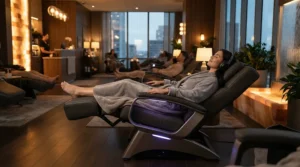
Buy the wrong recliner for a busy treatment room and you’ll know it within ninety days — not from a broken part, but from the slow creak of a frame that was never built for back-to-back clients. A heavy duty massage chair for high volume spas isn’t a fancier version of the chair someone has in their living room; it’s a piece of equipment engineered around a completely different math problem. Where a home chair might get used four or five times a week, a spa-floor unit can cycle through fifteen to thirty sessions a day, every day, for years. That’s the gap this guide is built to close. What is a heavy duty massage chair for high volume spas? It’s a reinforced recliner engineered with commercial-grade motors, welded or heavy-gauge steel frames, higher weight ratings, and wipeable upholstery designed to withstand continuous, multi-client daily use rather than occasional home relaxation. Below, we break down seven real, currently available models — from vending-style units built for lobby traffic to medical-grade chairs with commercial certifications — so you can match frame strength, weight capacity, and long-term serviceability to how your business actually runs. We’ll also get into the parts of ownership nobody puts in the brochure: how massage therapy research is still developing but points toward real benefit for pain and stress, and why the U.S. spa industry just posted record revenue with visits climbing toward pre-pandemic highs — which means more chairs are getting more use, more often, than ever before.
Quick Comparison Table
Before diving into the deep-dive reviews, here’s a fast-reference snapshot of how these seven chairs stack up on the two things that matter most for a business: how much abuse the frame can take and who it’s actually built for.
| Chair | Weight Capacity | Best For |
|---|---|---|
| Luraco i9 Max Plus | 300 lbs | Medical spas needing UL/FDA-listed commercial certification |
| Titan Jupiter LE Premium | 280 lbs | Big & tall clientele up to 6’6″ |
| Osaki OS-Pro First Class | 260 lbs | Mid-size day spas wanting SL-Track variety |
| Kahuna SM-9000 | up to 320 lbs | Wellness centers prioritizing raw weight tolerance |
| Infinity IT-6900 | 264 lbs | Lobbies, airports, and coin/card-op vending placement |
| JPMedics Kumo | 320 lbs | Spas wanting Japanese-built mechanical reliability |
| Daiwa Supreme Hybrid | 300 lbs | Premium spas offering a signature stretch-massage service |
Looking at the spread, the JPMedics Kumo and Kahuna SM-9000 post the highest published weight tolerances in this group, which matters a lot if your clientele skews larger or your chair sees walk-in traffic you can’t screen in advance. The Infinity IT-6900 stands apart because it’s not really a “spa chair” in the traditional sense — it’s a self-service vending unit, which makes it the better fit for unattended, high-footfall spots rather than a staffed treatment room. Meanwhile, the Luraco i9 Max Plus is the only chair here carrying full UL commercial certification out of the box, a detail that matters more than any spec sheet number once your insurance broker starts asking questions.
A quick tap now could save you an expensive mistake later — compare pricing before you commit.
Top 7 Heavy Duty Massage Chairs for High Volume Spas: Expert Analysis
1. Luraco i9 Max Plus — UL and FDA listed for commercial settings
The standout here isn’t a massage feature at all — it’s paperwork, and in a commercial setting, paperwork is what keeps you insured. Built in Arlington, Texas, the i9 Max Plus runs on a Split L-Track with Luraco’s patented “Butterfly” roller technology, a 120–170 degree recline range, and a chassis rated for 300 lbs across a 4’7″ to 6’10” height window.
What most buyers overlook about this model is that UL listing is legally required to use a massage chair in a commercial setting, and UL certification remains uncommon among imported massage chairs — so while competitors advertise “commercial use” loosely, this one can actually back it up on your compliance paperwork. This is the chair for medical spas, physical therapy-adjacent wellness centers, or any operator who wants zero ambiguity with their landlord or insurer about whether the equipment is rated for the space it’s in.
Aggregated reviewer sentiment across major massage-chair retailers consistently flags the chair’s near-silent motor and the value of its five-year parts warranty, though a handful of owners note the recline speed feels conservative compared to flashier residential models — a reasonable trade-off, since Luraco optimized for mechanical longevity over showroom drama.
Pros:
- ✅ Only chair here with full UL/FDA commercial certification
- ✅ Five-year parts and three-year service warranty as standard
- ✅ Quietest motor in this lineup per aggregated owner reports
Cons:
- ❌ Highest upfront price point in this roundup
- ❌ Manufacturer warranty explicitly excludes commercial use damage
At around $9,500–$11,500 depending on configuration, the Luraco i9 Max Plus isn’t the cheapest way to fill a treatment room, but if you need a chair you can defend on a compliance audit, the price buys peace of mind you can’t retrofit later.
2. Titan Jupiter LE Premium — engineered specifically for big & tall clients
If your spa serves a broad-shouldered, taller-than-average clientele, most “full body” massage chairs quietly fail them at the waist and footrest. The Jupiter LE Premium was built for users up to 6’6″ and 280 lbs, with a body-scanning system that maps shoulder height and back curvature before each session rather than assuming a standard frame.
The 3D roller mechanism travels in three directions across an L-Track, and the extendable footrest handles longer legs without the awkward gap you get on compact chairs. Based on the spec comparison against this group, its real differentiator is the combination of reach and voice control — staff can reset a session hands-free between clients, which matters when turnover is tight.
Reviewers on the manufacturer’s own retail pages repeatedly praise the strength of the air-compression system and the heat therapy, though a recurring complaint is that the touchscreen remote’s menu structure takes new staff a session or two to learn confidently.
Pros:
- ✅ Purpose-built for taller, larger-bodied clients
- ✅ Voice control speeds staff resets between sessions
- ✅ Body-scan technology recalibrates per-client automatically
Cons:
- ❌ Remote interface has a learning curve for new staff
- ❌ 280 lb cap is lower than the Kumo or SM-9000
Priced in the $5,500–$6,500 range, the Titan Jupiter LE Premium earns its keep in any spa where “does it actually fit our clients” is a real, recurring question rather than a hypothetical.
3. Osaki OS-Pro First Class — dual S/L-Track variety for mixed-use rooms
The Osaki OS-Pro First Class blends S-Track and L-Track geometry in a single mechanism, which in practice means it can contour the natural curve of the upper spine like an S-Track chair while still reaching down into the glutes and hamstrings like an L-Track. At a 260 lb rated capacity and a hefty 311 lb chair weight, this is a chair whose own mass works in its favor — a heavier base resists the wobble and shifting that shorten the life of lighter competitor frames.
What reviewers won’t tell you from the spec sheet alone is that the 23 pre-set programs are organized into four practical categories (VIP, Healthcare, Special, Relaxation), which matters operationally: staff can hand a client the remote and point at a category instead of explaining twenty-three unlabeled numbers.
Aggregated customer sentiment on major retail sites is generally positive on comfort and program variety, with the most common critique being that the touchscreen tablet’s response can lag slightly after extended daily use — worth flagging to any spa running the unit ten-plus hours a day.
Pros:
- ✅ Dual S/L-Track hits more anatomy in one session
- ✅ Heavy 311 lb frame resists wobble under repeated use
- ✅ Programs are grouped into clear, staff-friendly categories
Cons:
- ❌ Lowest weight capacity of the seven chairs reviewed
- ❌ Touchscreen response can lag after extended daily runtime
In the $4,200–$5,200 range, the Osaki OS-Pro First Class is the pragmatic middle-of-the-road choice for a general day spa that isn’t specializing in any one client demographic.
4. Kahuna SM-9000 — one of the higher weight tolerances in this class
The Kahuna SM-9000’s calling card is a six-roller infrared array — most competitors still ship with four — arranged in two triangular sets so the massage feels closer to two hands working simultaneously than a single point tracing your spine. Listings from Kahuna’s own retail network put the weight capacity at up to 320 lbs for users up to 6’5″, though some third-party listings cite 300 lbs; either figure sits at the top of this comparison.
Here’s what most spec sheets won’t tell you: the SM-9000 only needs about three inches of clearance behind it to fully recline, thanks to a sliding space-saving mechanism — a genuinely useful detail if you’re trying to fit chairs into a compact treatment room layout without sacrificing a full recline.
Aggregated reviews consistently praise the heated roller system reaching the seat and footwell (not just the lumbar area, where cheaper chairs stop), while a common critique is that only one zero-gravity position is offered, fewer than pricier competitors provide.
Pros:
- ✅ Highest advertised weight tolerance in this roundup
- ✅ Only 3 inches of wall clearance needed to fully recline
- ✅ Heat extends through seat and footwell, not just lumbar
Cons:
- ❌ Only one zero-gravity recline position offered
- ❌ No independent temperature control by body zone
At roughly $3,800–$4,600, the Kahuna SM-9000 delivers the best weight-capacity-per-dollar ratio in this group, making it a smart pick for wellness centers that can’t screen client body type in advance.
5. Infinity IT-6900 — built as a true self-service commercial vending unit
This is the odd one out on this list in the best possible way: the Infinity IT-6900 isn’t dressed up as a luxury recliner — it’s engineered from the ground up as a vending massage chair for businesses, with programmable pricing and a US Dollar Bill Validator that accepts a wide range of bills. That’s a meaningfully different design brief than every other chair on this list, and it shows: the mechanism and motors are explicitly described as commercial-grade, designed for frequent use in high-traffic areas, with a rated 264 lb capacity.
Practically, this makes it the right tool for lobbies, airport concourses, mall kiosks, or any high-footfall spot where you want revenue without staffing a dedicated attendant. The trade-off for that self-service design is fewer premium extras — no split L-Track, no body scanning — since every dollar of engineering went into durability and payment infrastructure instead of massage sophistication.
Owner feedback aggregated from commercial-equipment retailers consistently highlights the bill validator’s reliability as the standout feature, alongside a modest complaint that the massage intensity ceiling feels lower than dedicated treatment-room chairs.
Pros:
- ✅ Purpose-built commercial mechanism, not a converted home chair
- ✅ Integrated bill validator enables true unattended operation
- ✅ Lower unit cost than any treatment-room chair on this list
Cons:
- ❌ Fewer premium massage features than dedicated spa chairs
- ❌ Max intensity runs lower than higher-end treatment units
Around $3,000–$3,800, the Infinity IT-6900 isn’t competing with the rest of this list on massage sophistication — it’s competing on unattended revenue generation, and at that job, it’s arguably the best-suited chair here.
6. JPMedics Kumo — Japanese engineering with one of the widest tracks here
Japanese-made and mechanically distinct from the Chinese-manufactured majority of this list, the Kumo pairs a long L-Track — listed at 320 lbs recommended weight across various retailer spec sheets — with heated 4D rollers that protrude and travel along the spine to hit acupuncture-adjacent points rather than a generic up-down sweep.
Track length is listed anywhere from 44 to 53 inches depending on the retailer’s spec sheet, which is worth confirming directly with a dealer before ordering, but even at the conservative end it out-reaches most S-Track-only competitors. What the spec sheet won’t tell you, but reviewers note, is that the chair’s touchscreen and A.R.M. microprocessor combination handles auto-adjustment for different body types unusually smoothly — a real asset in a spa setting where the same chair sees a dozen different bodies in a single shift.
The manufacturer’s five-year limited warranty, including three years of in-home service, is also longer than most competitors’ base coverage.
Pros:
- ✅ One of the highest weight ratings in this comparison
- ✅ Long L-Track adapts well across varied body types
- ✅ Five-year limited warranty beats most competitors’ base term
Cons:
- ❌ Track length specs vary by retailer — confirm before ordering
- ❌ Fewer third-party spa-specific reviews than US-made competitors
Expect to pay $5,200–$6,200 for the JPMedics Kumo, positioning it as a strong mid-premium pick for spas that want mechanical reliability over flashy add-ons.
7. Daiwa Supreme Hybrid — dual-mechanism design for a signature stretch service
The Daiwa Supreme Hybrid’s headline feature is its HybriFlex track, a bendable L-shaped massage track that combines an inversion stretch with the massage track for the same effect as a yoga stretch. Two independent 3D roller mechanisms run simultaneously — one on the upper back and neck, one on the lower back and glutes — which cuts total session time without sacrificing coverage, a genuine operational advantage when you’re trying to maximize sessions per hour.
Most spec sheets from the manufacturer and its authorized retailers list a 300 lb capacity, though a couple of third-party retail pages advertise figures over 375 lbs; we’d recommend confirming the exact rating with an authorized Daiwa dealer before purchasing for a high-volume floor, since discrepancies like this are exactly the kind of detail that matters once real client weights start testing it daily.
The 70-airbag full-body compression system and 36 pre-programmed sessions give staff genuine variety to offer returning clients, and reviewers frequently cite the stretch function specifically as the reason they upgraded from a standard L-Track chair.
Pros:
- ✅ Dual-mechanism design massages upper and lower body at once
- ✅ Signature stretch function differentiates your service menu
- ✅ 36 pre-programmed sessions support varied client needs
Cons:
- ❌ Published weight capacity varies notably by retailer
- ❌ Among the priciest chairs in this comparison
At $8,000–$9,500, the Daiwa Supreme Hybrid makes the most sense for a premium spa that wants a genuinely differentiated signature offering, not just another recliner on the floor.
Massage Chair Maintenance for High-Traffic Spas: A Practical Usage Guide
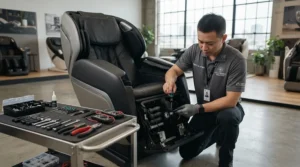
Running massage chair maintenance for high traffic spas well is less about heroics and more about a boring, repeatable schedule nobody skips. In the first 30 days, the most common mistake operators make is treating a new chair like a home unit — running it back-to-back all day without ever cycling it fully off. Give the motor a five-minute rest between long sessions during the break-in period; it lets internal components settle without accumulated heat stress. Weekly, wipe down all upholstery contact points with a non-alcohol cleaner (alcohol dries out synthetic leather and accelerates cracking), and visually check the frame’s mounting bolts, since vibration from daily cycling gradually loosens hardware that a home user would never stress-test. Monthly, inspect the air compressor lines for pinching or wear, since these fail quietly until a session simply doesn’t compress correctly. A frequently overlooked optimization: rotate which chair handles your longest, most intense programs if you run more than one unit, so wear distributes evenly instead of concentrating in your most popular treatment room. Most warranty voids trace back to skipped basic upkeep, not manufacturing defects — so the maintenance log is genuinely cheaper than the repair bill.

Real-World Scenarios: Matching Chairs to Your Spa’s Traffic and Scheduling Turnover
Scenario one: the boutique day spa with 20-minute scheduling turnover. A single-location spa doing back-to-back 20-minute add-on massages between facials needs a chair that resets fast and doesn’t require staff babysitting — the Osaki OS-Pro First Class or Kahuna SM-9000 fit here, since both offer clearly categorized presets a receptionist can start without a therapist present. Scenario two: the medical wellness center with insurance and liability concerns. A physical-therapy-adjacent practice where documentation matters needs the Luraco i9 Max Plus specifically for its UL/FDA listing — the certification paperwork alone can be the deciding factor when a broker asks what’s on the floor. Scenario three: the airport lounge or mall kiosk with unpredictable, unattended foot traffic. Here, spa scheduling turnover isn’t measured in appointments at all — it’s continuous, unscheduled walk-up use, which is exactly the environment the Infinity IT-6900‘s vending mechanism and bill validator were designed to survive without a staff member present for every transaction.
Commercial Massage Chair Weight Capacity for Spas: How to Choose the Right Rating
- Start with your actual client range, not the average. Commercial massage chair weight capacity for spas should be sized to your heaviest realistic regular client, not a national average body weight.
- Add a buffer above the stated maximum. Manufacturers rate chairs at their engineering limit, not a comfortable daily-use ceiling — treat the published number as a hard ceiling, not a target.
- Check whether the rating reflects total system stress, not just seated weight. Reclining and stretch functions add mechanical load beyond simple sitting.
- Match capacity to your locking mechanism, not just the frame. A high-capacity frame with a weak recline lock still fails under repeated heavy use.
- Ask for the commercial warranty terms specifically. Some manufacturers, including Luraco, explicitly exclude standard warranty coverage for commercial use unless you register under the correct commercial policy.
- Weigh height range alongside weight. A chair rated for high weight but a short height range will still misfit taller, heavier clients simultaneously.
- Confirm the number against multiple retailer listings. As seen with the Daiwa Supreme Hybrid in this guide, published capacities sometimes vary by seller — always verify with an authorized dealer before a high-volume purchase.
Durable Massage Chair Frame for Daily Use: Frame Welding vs Bolted Joints
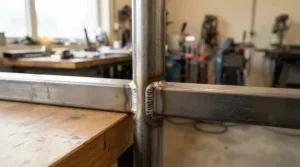
A durable massage chair frame for daily use comes down to one structural decision manufacturers rarely advertise clearly: frame welding vs bolted joints. Welded frames fuse structural members into a single continuous piece, which eliminates the joint-loosening failure mode entirely — there’s no bolt to work its way loose after ten thousand recline cycles. Bolted-joint frames are cheaper to manufacture and easier to ship flat-packed, but every bolted connection is a future maintenance point; vibration from daily commercial use gradually loosens torque, which is precisely why commercial lounge seating durability testing under ANSI/BIFMA standards includes leg load tests simulating hundreds of thousands of sitting cycles, plus stability and drop testing. Most massage chair manufacturers don’t publish which construction method they use, so ask directly before buying for a high-volume floor. In practice, heavier chairs like the Osaki OS-Pro First Class (311 lbs) and JPMedics Kumo tend to lean on more substantial welded sub-frames simply because a lighter bolted chassis couldn’t support their own working mass through thousands of annual cycles. If a manufacturer can’t answer the welding-versus-bolting question, that’s itself useful information about how seriously they’ve engineered for commercial life.
Replacement Cushion Availability and Long-Term Cost of Ownership
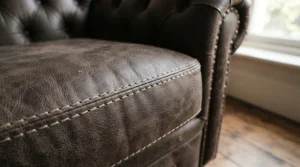
Replacement cushion availability is the single most underrated line item in a total-cost-of-ownership calculation, and it’s almost never mentioned in a sales conversation. Synthetic leather upholstery in a high-volume spa typically shows visible wear — cracking, seam separation, or color transfer from client clothing — within 12 to 24 months of daily multi-client use, dramatically faster than the 5-plus years a home chair might go. Before buying, confirm two things directly with the manufacturer: whether replacement seat, back, and armrest covers are stocked and sold separately (rather than requiring a full mechanism replacement), and what the typical lead time is. Chairs built around zippered, swappable cushion covers — a feature explicitly called out on the Kahuna SM-9000 — let you refresh the client-facing surface for a few hundred dollars instead of retiring an otherwise functional chair. Factor this into your ROI math: a $4,000 chair with readily available $150 replacement cushions and a five-year mechanical lifespan often beats a $6,000 chair whose upholstery isn’t sold separately and requires a full-unit swap at the first sign of wear.
Heavy Duty Massage Chairs vs Standard Residential Chairs: What Changes for a Spa
| Factor | Heavy Duty Commercial Chair | Standard Residential Chair |
|---|---|---|
| Typical daily cycles | 15–30+ sessions | 1–2 sessions |
| Weight capacity | 260–320+ lbs, verified | Often 250–300 lbs, rarely stress-tested |
| Frame construction | Often welded sub-frame | Frequently bolted joints |
| Warranty for business use | Explicit commercial terms available | Often voided by commercial use |
| Upholstery replacement | Cushions typically sold separately | Often requires full mechanism swap |
Looking at this comparison, the gap isn’t really about massage quality at all — a residential chair can feel just as good in a single demo session. The gap is entirely about what happens after month three of daily use: warranty validity, part availability, and whether the frame was ever tested against anything resembling your actual traffic. Buying a residential-grade chair for a high-volume floor because it “felt the same in the showroom” is the single most expensive mistake covered in the section below.
See which of these seven chairs matches your spa’s traffic — check current availability now. 🔧
Common Mistakes When Buying a Heavy Duty Massage Chair for a High-Volume Spa
The most expensive mistake is buying strictly on massage-feature checklists — track length, roller count, air cell totals — while ignoring weight rating and warranty terms entirely, then discovering the manufacturer’s standard warranty excludes commercial use once something breaks. A close second is under-ordering: buying one premium chair instead of two mid-range chairs, which sounds efficient until that single unit needs service and your entire massage-add-on revenue line goes dark. Operators also frequently skip asking about replacement cushion availability up front, only to learn eighteen months in that upholstery isn’t sold separately. Finally, many spas size for their average client rather than their heaviest realistic client, leaving the equipment under-specified for the exact population it needs to serve reliably every single day.
Frequently Asked Questions
❓ How long does a commercial massage chair typically last with daily use?
❓ Do heavy duty massage chairs need a special commercial warranty?
❓ What weight capacity should a spa look for in a massage chair?
❓ Can I run a massage chair back-to-back all day without damage?
❓ Is a vending-style massage chair worth it for a spa lobby?
Conclusion
Choosing a heavy duty massage chair for high volume spas ultimately comes down to matching frame engineering — not massage flair — to how your business actually operates day to day. If compliance and certification are non-negotiable, the Luraco i9 Max Plus is the clear answer. If your priority is raw weight tolerance across a broad clientele, the Kahuna SM-9000 or JPMedics Kumo earn their keep. Budget-focused operators building out a lobby or kiosk should look hard at the Infinity IT-6900, while spas wanting a genuine signature service differentiator will get more mileage from the Daiwa Supreme Hybrid‘s stretch function. Whichever you choose, remember that the sticker price is only the opening cost — replacement cushion availability, warranty terms for commercial use, and a maintenance routine you’ll actually follow determine whether that chair is still earning you money in year three or sitting broken in a storage room. Given that spa visits are climbing back toward pre-pandemic highs industry-wide, the equipment decision you make now is one your floor will be leaning on for years, not months.
Recommended for You
- 7 Top Rated Massage Chairs Of 2026: Budget-Friendly Picks
- Portable Massage Chair vs Stationary Salon Chair: 7 Picks For 2026
- 7 Best Kneeling Massage Chairs For Chiropractic Offices (2026)
Disclaimer: This article contains affiliate links. As an Amazon Associate, I earn from qualifying purchases. If you purchase products through these links, we may earn a small commission at no additional cost to you.
✨ Found this helpful? Share it with your fellow spa owners! 💬🤗
