
In This Article
Somewhere between your first client consult and your first equipment invoice, a question shows up that nobody warns you about: portable massage chair vs stationary salon chair — which one do you actually need? A portable massage chair is a lightweight, foldable seat designed to fold down into a carry case so a therapist can set up sessions anywhere — a client’s living room, an office break room, a festival tent. A stationary salon chair is a fixed, often hydraulic treatment seat bolted into a single studio space, built for durability over portability. Neither is objectively “better.” They’re built for two different businesses, and picking the wrong one early can quietly cap your income for years.
I’ve watched new massage therapists agonize over this decision more than almost any other startup choice, and honestly, it makes sense. This one purchase decides whether you’re driving to clients or waiting for them to walk in your door. It decides your overhead, your schedule, even how your back feels at 45. So before you swipe a credit card on either option, let’s actually dig into what separates these two categories — not in vague marketing language, but in real weight capacities, real setup times, and real dollars.
According to Bureau of Labor Statistics employment projections, massage therapist employment is expected to grow 15.4% between 2023 and 2033, which tells you something important: whichever chair you choose, the demand to support your decision is only getting bigger. You can dig into the full occupational outlook on the BLS site if you want the raw numbers behind that growth curve.
Quick Comparison Table
Before we get into the deep-dive on all seven chairs, here’s the bird’s-eye view for anyone skimming on their phone between clients.
| Chair Type | Weight | Setup Time | Best For | Price Range |
|---|---|---|---|---|
| EARTHLITE Vortex (portable) | 15 lbs | Under 3 minutes | Mobile therapists, tight budgets | Around $350-$450 |
| Master Massage PROFESSIONAL (portable) | 15.2 lbs | Under 3 minutes | New mobile businesses | Under $300 |
| Stronglite MicroLite (portable) | Lightweight | Under 4 minutes | First equipment purchase | Under $250 |
| EARTHLITE Avila II (portable) | ~25 lbs | Under 5 minutes | Premium mobile practice | $400-$550 range |
| Master Massage Rio (portable) | 24 lbs | Under 5 minutes | Heavier client loads, sports settings | Mid $300s |
| Baasha Professional Salon Chair (stationary) | Heavier, fixed | 15-30 min one-time assembly | Budget salon studio setup | Low-to-mid $200s |
| Best Choice Products Multipurpose Chair (stationary) | ~77 lbs | 20-40 min one-time assembly | Full-service studio/spa | Mid $200s-$300s |
Looking at the numbers side by side, the pattern is obvious: portable chairs win on setup speed and starting cost, while stationary chairs trade that convenience for weight capacity, comfort features, and the kind of “sit down and relax” client experience a studio can build a reputation around. If you’re weighing your very first purchase, the math usually tilts toward portable — but stick around, because “usually” is doing some heavy lifting in that sentence.
Found this comparison useful? A quick share helps other new therapists skip the guesswork.
Top 7 Portable & Stationary Massage Chairs: Expert Analysis
I pulled together seven real, currently available chairs spanning budget to premium, portable to stationary, so you can see exactly what your money buys at each tier.
1. EARTHLITE Vortex Portable Massage Chair Package — lightest chair on the market
The EARTHLITE Vortex earns its reputation the honest way: it’s built around an oval aircraft-aluminum tube frame that keeps total chair weight at just 15 pounds. That number matters more than it sounds like it should — carrying a 15-pound chair up three flights of stairs to a client’s apartment feels completely different from hauling a 30-pound one. The frame supports up to 300 pounds of client weight, and the dual-density Pro-Lite cushioning with Natursoft vinyl upholstery gives it a surprisingly plush feel for something this light. Based on the spec comparison, this is the chair to buy if your practice lives in your car trunk more than in a studio. Reviewers consistently note that the carry case and shoulder strap make the daily grab-and-go routine painless, though a few mention the sternum pad needs occasional readjustment for taller clients.
Pros:
- ✅ Genuinely the lightest chair in its category
- ✅ Quick face-cradle and armrest adjustments
- ✅ Compact nylon carry case included
Cons:
- ❌ 300 lb weight capacity is lower than some rivals
- ❌ Premium pricing compared to entry-level portables
Expect to pay in the around $350-$450 range at the time of research; check current price before buying, since availability shifts. For therapists who prioritize portability above all else, this is hard to beat.
2. Master Massage PROFESSIONAL Portable Massage Chair Package — best budget workhorse for new therapists
If the Vortex is the featherweight champion, the Master Massage PROFESSIONAL is the scrappy contender that punches way above its price tag. It weighs a nearly identical 15.2 pounds, but its aircraft-aluminum frame is rated for a working capacity in the hundreds of pounds beyond what you’d expect at this price point — a detail that matters if your client base skews toward larger body types.
What most buyers overlook about this model is the six-way adjustable face cradle, which lets you fine-tune positioning without fumbling through a manual. The exclusive small-cell foam cushioning system, layered from the chest bolster down, is denser than the foam you’ll find in bargain-bin alternatives, so it holds its shape after months of daily sessions instead of flattening out.
Additionally, aggregated reviewer sentiment describes the wheeled luggage-style case as a small but appreciated touch that spares your shoulder on longer walks to a client’s door.
Pros:
- ✅ High weight capacity for the price tier
- ✅ Wheeled case reduces carrying strain
- ✅ Adjustable height range fits most therapist statures
Cons:
- ❌ Upholstery isn’t as plush as premium tiers
- ❌ Limited color options compared to competitors
Priced under $300 in most listings, the Master Massage PROFESSIONAL is frequently the first serious purchase for therapists building a mobile business from scratch.
3. Stronglite MicroLite Portable Massage Chair Package — most affordable way to start mobile
Sometimes the best equipment decision is simply the one that doesn’t wipe out your starting capital. The Stronglite MicroLite is built for exactly that scenario. It ships with an adjustable chest pad, adjustable seat, leg support pads, and a velcro-removable face cradle — the essentials, without extra frills that inflate the price. Here’s what to weigh: this chair won’t dazzle anyone with luxury foam or designer upholstery, but for a therapist doing their first few mobile bookings, “functional and affordable” beats “gorgeous and unaffordable” every time. The removable, adjustable face pillow is a nice touch that some pricier competitors skip entirely. Based on the spec sheet, this chair is clearly positioned as an entry point rather than a long-haul investment — which is precisely why it’s on this list.
Pros:
- ✅ Lowest price point of the portable options here
- ✅ Removable, washable face cradle components
- ✅ Genuinely simple to fold, carry, and store
Cons:
- ❌ Fewer premium comfort features than higher tiers
- ❌ May need replacing sooner under heavy commercial use
At under $250, the Stronglite MicroLite is the classic “prove the business model works before you upgrade” chair.
4. EARTHLITE Avila II Portable Massage Chair — premium comfort for a wider client range
Once your mobile practice has some momentum, the EARTHLITE Avila II is where a lot of therapists reinvest. Its patented carbon-composite frame weighs around 25 pounds — heavier than the ultralight Vortex, but that trade-off buys you a 350-pound weight capacity and a height range that comfortably fits clients from 4’6″ to 6’6″. That’s a meaningfully wider range than most portable chairs manage, which matters if your clientele includes everyone from teenage athletes to NBA-height dads. The cloudfill poly-gel foam cushioning is noticeably plusher than standard foam, and reviewers consistently praise how it holds pressure relief over long sessions rather than bottoming out. What the spec sheet won’t tell you, but reviewers note, is that the sliding chest pad genuinely speeds up positioning between clients — a small mechanical detail that saves real minutes during back-to-back bookings.
Pros:
- ✅ Widest client height range in this lineup
- ✅ Premium poly-gel cushioning for longer sessions
- ✅ Wheeled ballistic nylon case for easier transport
Cons:
- ❌ Heavier than ultralight competitors
- ❌ Higher price tag limits it as a first purchase
Expect a price in the $400-$550 range; this is the “I’m serious about my mobile business” upgrade chair.
5. Master Massage Rio Portable Massage Chair — highest weight capacity in its class
For therapists working with athletes, larger-bodied clients, or anyone who’s tired of worrying about weight limits mid-session, the Master Massage Rio solves that anxiety outright. At 24 pounds with an aircraft-grade aluminum and fiberglass-reinforced construction, it carries a working capacity that dwarfs most portable competitors — a support rating well over 1,000 pounds combined structural tolerance, according to the manufacturer’s published specs. Reasoning through the numbers, that headroom isn’t really about serving 1,000-pound clients; it’s about long-term durability and peace of mind, since a chair rated conservatively tends to sag and squeak less over years of use than one running close to its limit daily. The 2-inch memory foam layered over small-cell foam cushioning is genuinely comfortable, and the removable kneeling pads are a thoughtful detail for clients with knee sensitivity. Aggregated review sentiment repeatedly calls out the 5-year warranty as a rare and reassuring feature in this category.
Pros:
- ✅ Exceptionally high support weight rating
- ✅ 5-year warranty, longer than most competitors
- ✅ Removable kneeling pads aid client comfort
Cons:
- ❌ Heavier than the ultralight tier chairs
- ❌ Chest and seat pad depth feels bulky to some users
Sitting in the mid-$300s price range, the Master Massage Rio is arguably the smartest mid-tier buy for anyone doing sports massage or working with a broad client demographic.
6. Baasha Professional All Black Salon Chair — best entry-level stationary hydraulic chair
Stepping into stationary territory, the Baasha Professional All Black Salon Chair represents the budget on-ramp into studio life. It’s a hydraulic styling chair built with a stainless-steel frame, PU leather upholstery, and a 360-degree swivel base rated to 330 pounds. Here’s what most first-time studio owners overlook: a hydraulic salon chair isn’t purpose-built for deep-tissue massage the way a dedicated treatment table is, but its adjustable height and reclining function make it genuinely versatile for lash work, facials, scalp massage, and light bodywork services layered into a broader menu. Reviewers describe the hydraulic pump action as smooth on delivery, though a subset mention that repeated heavy use can eventually introduce a slight wobble if the chair isn’t serviced. On paper, this means the chair rewards therapists who maintain their equipment rather than run it into the ground.
Pros:
- ✅ Genuine 360-degree swivel for multi-angle service
- ✅ Reclines for varied treatment positions
- ✅ Budget-friendly entry into stationary equipment
Cons:
- ❌ Not purpose-built for full-body massage tables
- ❌ Hydraulic pump may need servicing over time
Priced in the low-to-mid $200s, the Baasha Professional All Black Salon Chair is a smart pick for a hybrid studio menu rather than a massage-only practice.
7. Best Choice Products Multipurpose Massage Bed & Spa Chair — best all-in-one stationary treatment station
Rounding out the list, the Best Choice Products Multipurpose Massage Bed is the closest thing to a full studio centerpiece on this list. It’s a 71-inch treatment bed with a heavy-duty welded steel frame, faux-leather upholstery, and — notably — it ships with a matching hydraulic swivel stool, which is a genuinely underrated inclusion since most therapists buy a stool separately. Rated for up to 500 pounds and weighing roughly 77 pounds itself, this is unmistakably a “install it once and build your room around it” piece of equipment. What the listing won’t spell out, but the practical implication is clear: this bed suits facials, waxing, lash extensions, and massage under one roof, which is exactly the kind of multi-service flexibility a growing studio needs to diversify revenue. Reviewers consistently mention the removable armrests and head cushion as small details that make cleanup between clients faster.
Pros:
- ✅ Highest weight capacity of any chair here
- ✅ Included matching hydraulic stool
- ✅ Versatile across multiple service types
Cons:
- ❌ Requires permanent floor space, not portable
- ❌ Assembly and setup take real time upfront
Expect pricing in the mid-$200s to $300s range, making it a strong value anchor for a first stationary studio investment.
Practical Usage Guide: Getting Your First Chair Set Up Right
Buying the chair is the easy part. The first 30 days of actually using it is where most new therapists either build good habits or bad ones. If you’ve gone portable, practice your fold-and-unfold sequence at home before your first paid booking — nothing shakes client confidence like fumbling with straps in their entryway. Learn your chair’s specific adjustment points (face cradle angle, armrest height, chest pad tilt) until you can dial them in without looking, because clients notice hesitation. For stationary chairs, the equivalent first-30-days habit is a maintenance rhythm: check hydraulic pump action weekly, tighten any visible bolts monthly, and wipe down upholstery after every single client, not just at the end of the day. A common mistake with portable chairs is skipping the carry case padding check — a scuffed frame corner today becomes a wobble in six months. With stationary equipment, the equivalent mistake is ignoring a slow hydraulic descent until it becomes a full pump failure mid-session.

Massage Chair Setup Time Comparison
This is one of the most searched practical questions in the whole portable-vs-stationary debate, so let’s answer it directly. A quality portable chair, once you’ve practiced the sequence a handful of times, folds out and locks into position in under three to five minutes — the EARTHLITE Vortex and Master Massage PROFESSIONAL both land at the faster end of that range because of their simplified locking mechanisms. A stationary chair like the Baasha Professional All Black Salon Chair or the Best Choice Products Multipurpose Massage Bed requires a one-time assembly that typically runs 15 to 40 minutes depending on the model, but after that initial setup, there’s zero daily setup time at all — you just walk into the room and go. The real comparison isn’t “fast versus slow,” it’s “repeated small time cost versus one upfront time cost.” If you’re doing five mobile appointments a day, those three-minute setups add up to real minutes lost to logistics. If you’re running a fixed studio, that time cost disappears entirely after installation day.
First Equipment Purchase for New Massage Business
If you’re staring at a blank spreadsheet trying to figure out where your first dollars should go, here’s the honest answer: for the overwhelming majority of new massage therapists, the first equipment purchase should be a portable chair, not a stationary one. Here’s the reasoning. A portable setup like the Stronglite MicroLite or Master Massage PROFESSIONAL lets you test your service, pricing, and client demand without committing to a lease, a studio buildout, or fixed monthly overhead. You can pivot, adjust your offerings, or even pause the business temporarily if life gets in the way — none of which is realistic once you’ve signed a studio lease and bolted a Best Choice Products Multipurpose Massage Bed to the floor. Once you’ve proven you can consistently book 15-20 sessions a week and your car trunk starts feeling like a second office, that’s your genuine signal to start pricing out stationary equipment and studio space, not before.
How to Choose Between Portable and Stationary
Picking the right category comes down to five honest questions, answered in order:
- What’s your current client volume? Under 10 sessions a week strongly favors portable; consistent, growing volume opens the door to stationary.
- What’s your available startup capital? Portable chairs typically run several hundred dollars less than a full stationary setup with room buildout costs factored in.
- Do you have a fixed location already? If you’re renting studio space or working from a dedicated home room, stationary equipment stops being a liability and starts being an asset.
- How physically demanding is daily setup for you? Repeated stairs, elevators, or long walks to client homes make portability a real ergonomic consideration, not just a convenience.
- What’s your five-year vision? If you picture a full-service spa down the road, stationary equipment purchased strategically now can double as your studio’s foundation.
Reasoning through these five questions honestly, most new therapists land on portable equipment for their first one to three years, then transition once client volume and capital both justify the shift.
Choosing Between Mobile and Salon Massage Practice
The equipment question is really a proxy for a bigger one: are you building a mobile practice or a salon-based one? A mobile massage practice means you travel to clients — homes, offices, hotels, event venues — and your chair choice needs to reflect that constant transport. A salon-based practice means clients travel to you, and your equipment can prioritize comfort and durability over portability since it never has to leave the room. Mobile practices generally have lower overhead and faster startup timelines, since there’s no lease or buildout involved, but they trade that for more time spent driving and less control over the treatment environment — noisy apartments, awkward room layouts, and unpredictable parking are real occupational hazards. Salon-based practices require more upfront investment and often a longer runway before profitability, but they offer a controlled, brandable environment and the ability to layer in additional services like facials or retail products that a mobile setup simply can’t support.
Mobile vs In-Studio Business Models
Beyond the physical equipment, mobile and in-studio models genuinely function as different businesses with different financial shapes. A mobile model typically has lower fixed costs (no rent, no utilities for a dedicated space) but higher variable costs per session in the form of travel time, gas, and vehicle wear. An in-studio model flips that: higher fixed monthly costs from rent and utilities, but lower variable costs per session since there’s no drive time eating into your schedule. Mobile therapists often report being able to charge a premium for the convenience factor, while in-studio therapists benefit from being able to book back-to-back appointments with essentially zero transition time. Neither model is inherently more profitable — the profitability depends entirely on your local market’s client density, your pricing structure, and how efficiently you fill your schedule either way.
Chair Storage Requirements
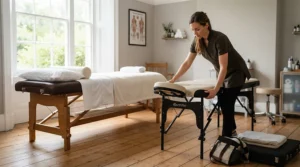
Storage is one of those practical details that rarely makes it into equipment marketing copy, but it absolutely affects your day-to-day life. A folded portable chair like the EARTHLITE Vortex or Master Massage Rio typically stores in a closet corner, a car trunk, or even leaned against a wall in its carry case — realistically under two square feet of floor space when not in use. A stationary chair like the Best Choice Products Multipurpose Massage Bed demands permanent, dedicated floor space, typically six to seven feet of length plus clearance on both sides for the therapist to move around the client. If you’re working from a home-based practice with limited square footage, that difference is often the deciding factor all on its own — a spare bedroom can absorb a folded portable chair in a closet, but it may not comfortably fit a fixed 71-inch treatment bed with walking clearance on both sides.
Client Volume Planning
Matching your equipment to realistic client volume projections prevents two common and expensive mistakes: under-investing when you actually have steady demand, or over-investing before demand exists. If you’re booking fewer than 10 sessions weekly, a single portable chair like the Stronglite MicroLite covers your needs completely, and any additional spending is premature. Between 10 and 25 weekly sessions, it’s worth upgrading to a more durable portable chair like the EARTHLITE Avila II or Master Massage Rio, since daily wear accelerates noticeably at that volume. Past 25-30 sessions weekly with consistent, predictable demand, a stationary setup starts making genuine financial sense, both because the durability of something like the Best Choice Products Multipurpose Massage Bed is built for that pace, and because you’ll likely want a base of operations rather than continuing to drive between appointments.
Common Mistakes When Buying a Massage Chair
The single most common mistake is buying based on price alone without checking weight capacity against your actual client base — a chair rated for 300 pounds that regularly serves larger-bodied clients is a safety issue waiting to happen, not just a comfort one. The second is underestimating how often a portable chair gets folded, unfolded, and thrown in a trunk; chairs bought for occasional home use often fail faster under daily commercial cycling than their specs suggest. Third, many new therapists skip reading the fine print on warranty coverage, then discover a cracked frame or torn upholstery isn’t covered because the damage was classified as commercial wear rather than a manufacturing defect. Finally, therapists sometimes buy stationary equipment before they have a fixed location secured, leaving an expensive treatment bed sitting in storage generating zero revenue.
Long-Term Cost & Maintenance
Total cost of ownership tells a different story than sticker price alone. A budget portable chair like the Stronglite MicroLite might cost under $250 upfront, but if it needs replacing after 18 months of heavy commercial use, its effective annual cost can actually exceed a pricier chair like the Master Massage Rio, which is built with a longer warranty and more durable materials from the start. Stationary chairs carry their own long-term math: a hydraulic pump on the Baasha Professional All Black Salon Chair may need occasional servicing, and upholstery on high-traffic stationary equipment tends to wear faster than portable chairs simply because it sees more total client-hours per week. The practical takeaway is to calculate cost-per-session rather than cost-per-chair when comparing options — a $450 chair used for 2,000 sessions over its lifespan costs you roughly 22 cents per session in equipment alone, which puts the sticker price in a much more useful perspective.
Safety / Regulations / Compliance Guide
Regardless of which chair category you choose, most U.S. states require massage therapists to hold a professional license, and your equipment choices should align with your state board’s specific space and sanitation requirements. Mobile therapists should confirm their state doesn’t impose additional liability requirements for off-site services, since insurance terms sometimes differ between studio-based and travel-based practice. Stationary equipment installed in a rented studio space typically needs to meet local health department sanitation standards, including washable, non-porous upholstery — a detail worth double-checking before finalizing a stationary purchase. On the business side, the Small Business Administration’s guidance on launching a home-based service business is a genuinely useful starting point for understanding licensing and permit requirements that vary by city and county, regardless of which chair type you ultimately choose.
Frequently Asked Questions
❓ Is a portable massage chair as comfortable as a stationary chair?
❓ How much weight can a portable massage chair hold?
❓ Can I start a massage business with just a portable chair?
❓ Do stationary salon chairs require professional installation?
❓ Which is more profitable, mobile or in-studio massage practice?
Conclusion
At the end of the day, the portable massage chair vs stationary salon chair decision isn’t really about which product wins some abstract spec battle — it’s about which one matches the business you’re actually running today, not the one you hope to run in five years. Start where your client volume and capital genuinely are. A portable chair like the Stronglite MicroLite or Master Massage PROFESSIONAL gets a mobile practice off the ground with minimal risk, while a stationary setup like the Best Choice Products Multipurpose Massage Bed rewards therapists who’ve already proven consistent demand and secured a fixed location. Most successful practices I’ve researched didn’t pick one forever — they picked the right tool for their current stage, then upgraded deliberately as volume grew. That’s the real lesson here: match the equipment to the evidence, not the other way around.
Recommended for You
- 7 Best Kneeling Massage Chairs For Chiropractic Offices (2026)
- Stationary Massage Chair For Salon Owners: 7 Picks For 2026
- Portable Massage Chair For Mobile Massage Therapists: 7 Best (2026)
Disclaimer: This article contains affiliate links. As an Amazon Associate, I earn from qualifying purchases. If you purchase products through these links, we may earn a small commission at no additional cost to you.
✨ Found this helpful? Share it with a fellow massage therapist deciding between mobile and studio life! 💬🤗
